| |
More important than who is elected is the
participation of a majority of voters.
By Medi Shams, Shahrema Persian weekly
magazine Columnist
Saturday July 07, 2022
Translated from the Persian article
June 23, 2022
You must be
wondering which election I am talking about. And if I
tell you this is about the 2022 Toronto municipal
election on Monday, October 24, maybe you would like to
know why we should talk about it four months in advance.
You may be more surprised if I invite you to participate
in a campaign now.
We are right
to believe that it is hard to attract people's attention
to an event that will happen far from now. Especially
when it is about elections that, over time, we pay less
and less attention to and when it comes to the municipal
elections, many of us believe it isn't worth thinking
about them.
Political
parties are involved in provincial and federal
elections, which have a long history, and people are
familiar with them. Parties have power and benefit from
the financial support of the public and the government.
As a result, it does not take long for the candidates to
introduce themselves and mobilize people toward the
elections. However, we see even at these two levels,
participation is declining.
Municipal elections are
non-partisan, and each candidate acts independently.
Therefore, the decision-making and registration of
candidates are easier, starting about five months before
the elections. This year, candidate registration began
on
Monday, May 2 and will
continue until Friday, August 19. Early elections will
start on Friday, October 7, and will continue for a week
until Friday, October 14. And finally, elections will be
held on Monday, October 24. Election signs must be
collected in the following three days by Thursday,
October 27.
By the end of the four-year term
in 2014, Toronto had one mayor and 44 Councillors. In
that election, candidate registration began in January,
ten months before the election. One of the candidates
managed to join the city council with only
18% of the votes in her
riding, which was the lowest percentage of votes in the
history of Canada.
In July 2018, Ontario Prime
Minister
Doug Ford, one month after
winning the June 2018 election, reduced the number of
ridings from 44 to 25, equal to the number of provincial
and federal ridings. As a result, wards 23 and 24 of
Willowdale became ward 18, with a population of about
118,801 and 75,841 voters.
In the 2014 municipal election,
John Filion in
ward 23 and David Schiner in
ward 24 won the election with
14,128 (55.29%) and 10,716 (55.17%).
David Mousavi was second
behind John Filion with 7951 votes (7951). With 40.28%
of the votes, John Tory defeated Doug Ford (33.73%) and
became the mayor of Toronto. In 2014, 55% of eligible
voters participated in the municipal election.
In the
2018 election, John Filion,
with 8104 votes (31%), succeeded in keeping his
Councillor position which he had held since 1981.
Eighteen candidates competed in that election, five of
whom were from Iranian backgrounds - David Mousavi, 1596
votes, fourth place; Sam Moeini, 1289 votes, seventh;
Saman Tabasinejad, 1189 votes, eighth; Farah Aslani, 187
votes thirteenth, and Hamid Shakeri, 122 votes fifteenth
place.
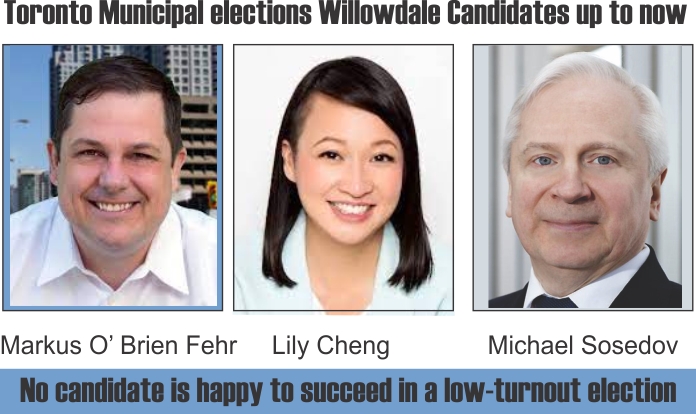
To date,
three candidates have
registered for the current municipal elections. Michael
Sosdovo is the first candidate to register on May 2,
Lily Cheng on June 13 and Marcus O'Brien Fehr on June 14
after John Filion announced on June 12 that he would
not seek re-election this
fall.
This year, Willowdale's
circumstances prompted me to get the community's
attention several months before and change my attitude.
It is safe to say that we will have fewer candidates in
this ward because, with the resignation of John Filion
after forty years in politics and service to the people,
the main competition will be between Lily Cheng and
Marcus O'Brien Fehr. In the 2018
election, each of them announced
their candidacy in one of the two Willowdale ridings.
John Filion endorsed both. But due to changes in the
number of ridings and
other reasons, John Filion
changed his mind and returned to the election. As a
result, Marcus Fehr withdrew and supported John Filion,
and Lily Cheng continued to run and finished in second
place with 5,149 votes (20%).
By
supporting all candidates, I intend to initiate a
non-partisan campaign to promote the participation of
the people of Willowdale. One of the reasons for the
declining voter turnout in elections, especially in
municipal, is the negative image that people have of
politicians and even of councillors.
Although the
two main candidates may be very different in terms of
experience and characteristics in the coming municipal
election, there is no doubt about their competence and
merit. In this circumstance, it would be in the interest
of all to focus on how to increase the turnout, which
could allow us to have a representative with a high
level of support. Especially since both candidates have
no prior experience as city councillors, we can not
expect them to face the greedy developers in an area
like Willowdale, which is experiencing maxim
development.
Therefore, I intend to focus our
attention on this issue and dedicate my weekly articles
to the elections. I have set up a
website,
Facebook page and
Twitter account under the
title "Willowdale Vote!". This is, for me, the beginning
of a non-partisanship campaign to promote voter
participation that will continue even after and until
the next election.
Not only do
elections, the voting system, political parties, and
democracy need to be reviewed and reformed, but we must
realize that we cannot see the change we want until our
attitudes toward the neighbourhood and neighbours
change. Our citizen role and obligation do not start and
end with casting a ballot. We must realize that without
our permanent support, our representatives will not be
able to face the profiteers who exploit society's
weaknesses for their maximum benefit.
What John Filion wrote in his
April
newsletter is not limited to
the weaknesses of the city council and the provincial
appointed courts' unfair bias in favour of developers.
He has a message that speaks to the law's shortcomings,
the system's weaknesses, and the dangers threatening
democracy.
|
|
|